
Mastering Advanced Web Attacks: Why the OSWE Certification is a Must-Have for Security Pros
- pass yourcert
- Apr 17
- 5 min read

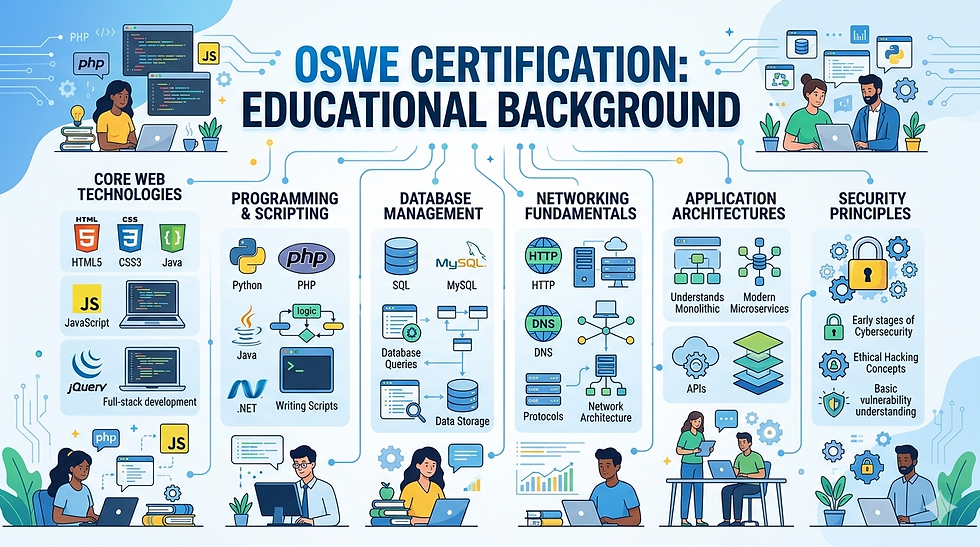
The landscape of cybersecurity is shifting rapidly. While automated scanners and basic vulnerability assessments were once sufficient to protect an organization, the rise of complex, custom-built web applications has created a demand for a deeper level of expertise. Enter the OffSec Web Exploitation (OSWE) credential. If you are looking to move beyond black-box testing and dive deep into white-box analysis, the OSWE Certification is the gold standard that proves you have the skills to deconstruct, analyze, and exploit modern web infrastructures.
What is the OSWE Certification?
The OSWE is the cornerstone of the OffSec Web Expert (AWAE) learning path. Unlike many other security certifications that focus on using tools to find common flaws like SQL injection or Cross-Site Scripting (XSS), the OSWE focuses on White-Box Web App Penetration Testing.
White-box testing means you aren't just looking at the front end of a website; you are looking at the source code itself. You are analyzing how the application handles data, how it manages sessions, and how logic flaws can be chained together to achieve Remote Code Execution (RCE). It is a rigorous, hands-on certification that requires candidates to bypass security filters and exploit vulnerabilities that automated tools simply cannot find.
The Purpose of OSWE Online Training
The journey to becoming an OSWE begins with the Advanced Web Attacks and Exploitation (AWAE) course. This online training is designed to bridge the gap between "knowing" a vulnerability exists and "understanding" why it exists at the code level.
1. Developing a White-Box Mindset
The primary purpose of the online training is to shift your perspective. Instead of throwing payloads at an input field, you learn to read PHP, JavaScript, Java, and .NET code to identify weak sanitization routines or flawed authentication logic. You become an investigator of logic, not just a runner of scripts.
2. Mastering Vulnerability Research
The OSWE training isn't about memorizing a static syllabus; it’s about the methodology of research. You are taught how to find "0-day" style vulnerabilities in custom web applications. This includes learning how to decompile binaries and analyze complex middleware to find hidden entry points that external scanners would never see.
3. Skill Chaining for Impact
In the real world, a single low-level bug might not be a significant threat. However, the online training teaches you how to chain a small File Read vulnerability with a Session Hijacking flaw to eventually gain full administrative control. This "exploit chaining" is the hallmark of a true security expert.
Deep Dive: What You Will Learn
The OSWE curriculum is famously intense. It covers a wide range of advanced topics that are critical for modern web security:
Cross-Site Scripting (XSS) to RCE: Moving beyond simple "alert" boxes to actually executing code on a server.
SQL Injection (SQLi): Learning manual exploitation techniques in complex environments where tools like SQLMap fail due to custom WAFs or unique filtering.
XML External Entity (XXE) Attacks: Exploiting how applications parse XML data to read internal files or perform SSRF.
Insecure Deserialization: One of the most critical flaws in modern Java and .NET applications, leading to complete system compromise.
Bypassing Authentication: Learning how to manipulate JWT (JSON Web Tokens) and session management to impersonate high-privilege users.
The Exam: A True Test of Grit
The OSWE exam is legendary in the cybersecurity community for its difficulty and realism. It is a 48-hour hands-on practical exam, followed by another 24 hours to submit a professional documentation report.
During the 48 hours, you are tasked with gaining access to specific systems by identifying vulnerabilities in the source code provided to you. There are no multiple-choice questions. It is a grueling test of your technical ability, your time management, and your mental endurance. Earning the OSWE means you didn't just study—you survived a high-pressure simulation of a real-world breach.
Why Choose OSWE Over Other Certifications?
While certifications like the CEH or even the OSCP provide a great foundation, the OSWE is a specialized "Level 300" course. It is intended for those who want to reach the pinnacle of web security.
High Market Demand: Companies building their own software (SaaS providers, Fintech, etc.) desperately need security engineers who can perform deep-dive code reviews.
Credibility: Because of its notorious difficulty, the OSWE carries immense weight on a resume. It tells employers you are capable of deep-dive technical work without hand-holding.
Hands-On Labs: OffSec provides a dedicated lab environment where you can practice the attacks on real-world software versions in a safe, controlled setting.
Preparing for Success: Tips and Tricks
If you are planning to take on the OSWE, preparation is key. Here is how you should approach it:
Brush up on Scripting: You will need to write your own exploit scripts. Being comfortable with Python is almost mandatory for automating your findings.
Understand Web Frameworks: Familiarize yourself with how Java Spring, .NET MVC, and Node.js applications are structured.
Practice Manual Testing: Start looking at open-source projects on GitHub. Try to find vulnerabilities by reading the code rather than using a scanner.
Join the Community: The OffSec community on Discord and various forums are great places to discuss concepts and get unstuck during your lab time.
Frequently Asked Questions (FAQs)
Q1: What are the prerequisites for OSWE? While there are no hard requirements, you should have a solid understanding of web technologies (HTML, JavaScript, SQL) and scripting. Many find it helpful to complete the OSCP first to get used to the OffSec methodology. Q2: How long does the online training take? The content is vast. Most students spend between 2 to 4 months working through the material and the labs before feeling confident enough to attempt the 48-hour exam. Q3: Can I use automated tools during the exam? The OSWE is a white-box exam focusing on manual exploitation. Automated vulnerability scanners (like Burp Suite’s Pro Scanner) are restricted. You are expected to find the bugs manually through code analysis. Q4: What is the passing score? You earn points by achieving specific milestones, such as gaining a local shell or administrative access. You must reach the required point threshold and submit a comprehensive report to pass. Q5: Does the OSWE certification expire? No. The OSWE is a lifetime certification. Once you earn it, you hold the title forever without needing to pay annual maintenance fees.
Conclusion
The path to becoming an OffSec Web Expert is challenging, but it is one of the most rewarding journeys a security professional can take. By focusing on the intricacies of source code and the logic of web applications, you move from being a generalist to a master of exploitation. Whether you are looking to advance your career or simply want to understand the web at its deepest level, the OSWE Certification provides the tools, the training, and the prestige to help you reach your goals. Embrace the challenge, dive into the code, and join the elite ranks of web security experts.


Comments